
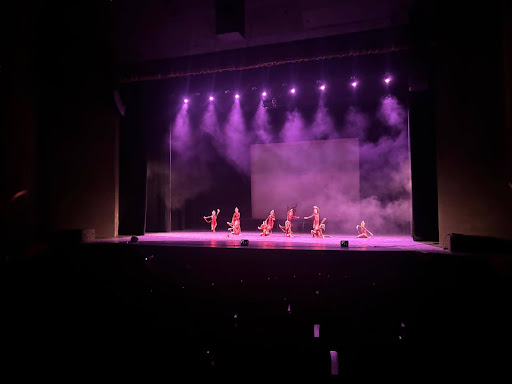
Something has changed inside. “It kind of feels like an empty house.”
After the black heavy curtains slide across the now bright and cheerful auditorium, the night carries on with ice cream and food, delaying the end just a little longer. Eventually, the costumes are folded and tucked into the back of the closet, never to see the light of day again. At home, the bobby pin pile finally topples over as the collection of little metal pieces continues to grow, serving as a reminder that the performance is over.
A shower rinses away all the worn-off adrenaline. That should be the end of it—a smooth shift between the chaos of a performance and normal life. But for Alex Headley, dancer for 11 years and a senior at OHS, the morning after feels like “an empty house.”
“Homes are things we put a lot of love into,” she explains. “We work on them and try to make them the best we can, because they’re a reflection of us. But eventually, when we have to move, we pack everything up and say goodbye to this place that held so many memories. Then we go to a new place and start all over. That’s what it feels like: you’re sad to leave, but also a little happy about the possibility of a bigger, better space. Still, you’re grieving the loss of the place you no longer get to spend time in.”
For Headley, that feeling hits hardest after her biggest roles. This past year, Headley got to be her studio’s Sugar Plum Fairy. As a child, she remembers being a baby angel with a harp, where her role incorporated simply walking onstage and waving at her parents. For her, “seeing the Sugar Plum Fairy back then felt like such a big moment. I remember watching the dancers from backstage, completely in awe. So getting to the Sugar Plum Fairy role now felt like a huge full-circle moment. Like, oh my gosh… I am that person for these younger kids.”
When preparing for this role, Headley spent around two years training outside of the dance studio, dedicating a couple of hours every week to her gym, where she practiced pointe and the turn sequence required for her tryout. Headley spent so much of her time over the years preparing for that role that when she finally got the role of Sugar Plum, “it was amazing.”
However, that moment no longer seemed as important when applause roared in the audience. It was about a month after the show that it truly hit her. As she was stretching on the floor while everyone else was leaving practice, she realized, “Oh my gosh, it’s over. I trained and trained and trained for a role that I got to do twice in front of an audience, and then I was done.”
Headley mentions how this realization made her see the studio in a different light. She started to realize that “I would never practice that solo in that room again. A realization that not only is the role ending, but also the dream of having that role. It’s not dying, but it is no longer possible because it’s done.”
She realizes that she was so focused on the technique of the role that she didn’t take the time to truly relish the moment of “I did it” and the journey that led up to it.
For theater performers, the “empty house” extends beyond just the show to the characters they develop deep relations with as they work to understand and portray the inner emotions of the characters they represent.
Emma Griffith, a junior at OHS and a seasoned theater performer, explains how she stepped into the character’s mind. “I didn’t know where I started and where I ended and where Lady M began.”
For Griffith, embodying the role of Lady Macbeth made her feel “powerful and strong and confident.” The emptiness that followed wasn’t just about the performance being over, but also saying goodbye to someone she lived as, and someone who reshaped how she saw herself.
This strange and sometimes awkward in-between feeling, a feeling after a chaotic but fulfilling performance, isn’t exclusive to dancers or theater performers. Even though their worlds revolve around competitions and competition seasons, compared to a stage and performances that occur biannually, figure skaters and ice dancers also relate to it.
Hana Aboian, a sophomore at OHS, who has been skating for twelve years, describes this aftermath as not just emptiness, but also as a “crash.”
“After an event, there’s a week or two of slowing down,” she says. “People don’t realize how much time goes into this. They see something that looks effortless, but for there to be effortless, there has to be effort.”
When the season ends, Aboian describes the aftermath as a “wave of exhaustion,” a break from the months of training and adrenaline from the competitions. She describes this feeling as a mix of relief and sadness.
Sometimes these feelings don’t wait until after the season ends, and can be experienced right after a performance. Clare Fayad, a junior at OHS and a figure skater for eight years, notes how it can be really hard on her mentally if she doesn’t do as well as she wanted to. “You just keep imagining what you could have done differently,” Fayad says.
Research on post-performance rumination suggests that the emotional impact of a performance does not end when the stage empties, but can linger for days through persistent positive and negative thoughts. In this light, Fayad’s sense of regret and Aboian’s feeling of loss reflect such an aftermath—a sadness that comes with falling short in the moment they practiced hours for. Even for performances that do go well, Aboian highlights how, towards the end of a program, you feel emotionally attached.
“Halfway through the program, you’re almost done, and all the hard elements are over. So the only relatively easy things are left. It kind of feels like your soul steps away from your body, and you take a deep breath.” Aboian adds, “There’s this pause in the show or the performance that leaves you really emotionally attached. Every performance has its own emotions tied to it, and it really comes down to where you are when you are.”
While the emptiness may feel isolating in the moment, Griffith points out that it isn’t unique to theater, dance, or skating. “It applies to all kinds of art,” she says. “When it’s over, and that rush of creativity is gone, you feel kind of spent and sad, but it’ll come again. It just takes time.” The feeling lingers not because one made a mistake, but because something meaningful and creative engulfed us within it.