
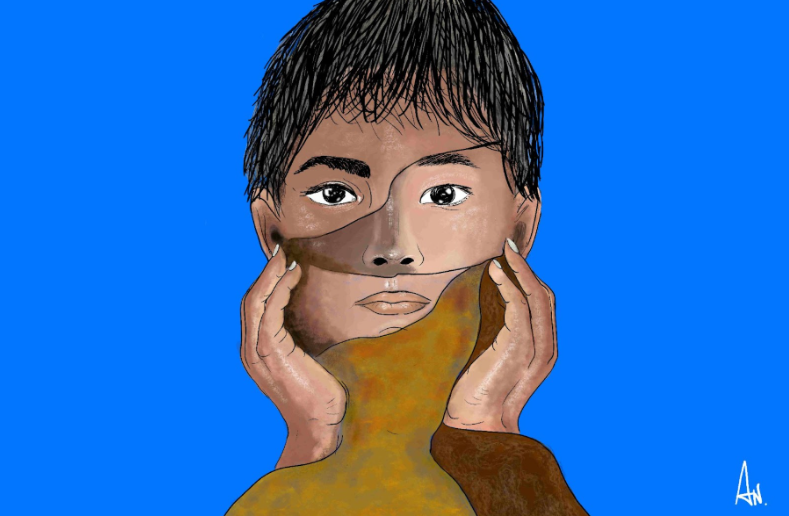
Moving from a cosmopolitan city in South America to a small European town, I didn’t expect to discover that my character and education would be overshadowed by my “otherness.”
It made me think about the elastic meaning of words that adorn the municipal buildings and schoolroom walls of a neighbouring European country: Liberté, égalité, fraternité. Words which have established constitutions and justified revolutions. Words which reflect the European talent for congratulating itself on its Enlightenment inheritance while maintaining a quiet but sturdy gate at the entrance. In some corners of Europe, these ideals seem to function less as universal guarantees and more as heirlooms. And as heirlooms go, they are not intended for everyone.
In the more cosmopolitan European cities, the promise of those ideals does feel like a reality. People of every color and accent can be found living in neighbourhoods spread across Lisbon, Paris, Barcelona, and Berlin. The cafés are filled with different languages, universities publish brochures in English, and billboards feature faces which would not have been there a few generations ago.
This image changes in the smaller towns. There, “otherness” often feels like you’re trying to divide a number by zero. It can only result in an undefined, unsolvable puzzle.
You might walk into a cafe and be welcomed politely but somehow still feel like your presence has managed to unsettle some kind of “perfect geometry” that has existed for centuries. From there, it only takes a few moments for the Enlightenment to revert to a closed circle with you left standing outside of it.
If you try to articulate this feeling, you may be reminded that Europe has suffered enough self-examination and the “race card” is after all an American concept. The problem here, you are often told, is cultural assimilation, not color.
This sometimes feels like an ever-moving goalpost of trying to look and act less like yourself. The entire burden of cultural assimilation is put on your shoulders, completely ignoring the systemic bias that exists. This persistent weight slowly erodes your optimism and you are left trying to adjust between the lofty ideals you had imagined and the reality of being left standing outside the circle.
As a young person arriving from South America, I had naively hoped that the birthplace of so many universal ideals would have perfected their thinking. However, though Enlightenment might have established the rulebook for Europeans to follow, it relegated the Global South to the stereotype of a chaotic set of entities incapable of self-rule. This then served as the rational basis for extending European structures and “civility” to them. When cultural assimilation is brought up today, it is an attempt to invoke this historical ideology of being superior to the more “primitive” cultures.
But this is not a list of grievances because on this same continent, in these same smaller towns, there are things that endear you to it.
In Portugal, when the icy Atlantic wind slices across the sand, people sit in their cars and read a book, while watching the sunset. For them, reading is not a performance which needs to be shared on the ’gram but a natural habit of being. Children are enrolled in music lessons with a seriousness that is usually reserved for catechism classes where I come from. Attending a neighborhood classical music concert is a normal Friday evening affair. Apprenticeships are respected. And houses don’t have alarm systems or barbed wires running across their boundary walls.
But what remains outside those walls is the rest of the world. For folks living in smaller European towns, the Global South, whether American or Asian, is still thought of as a dangerous combination of poverty and peril.
These judgments are not gleaned from lived experience nor world travel, yet they are held onto with steadfast confidence. Here, information is drawn from regional television channels or from the uncle whose wife’s friend once worked abroad.
And yet. A few days ago, I was in my town’s supermarket and accidentally took a shopping cart that wasn’t mine. A woman approached me with an anxious expression. I braced myself for suspicion or for a harsh remark. But this time that sturdy gate wasn’t slammed shut in my face. Instead, she apologized to me. It was a common mistake, one she often made herself, and said she was sorry for the confusion.
It was a small moment, almost laughably so. There was no revolution. But I felt lighter walking back home that day. Perhaps this is how one survives, not by waiting for the “heirlooms” of Enlightenment to be shared, but by storing these small acts of kindnesses. The “perfect geometry” of establishments might be a closed circle as of now, but in the messy reality, the aisles are wide enough to hold you.