
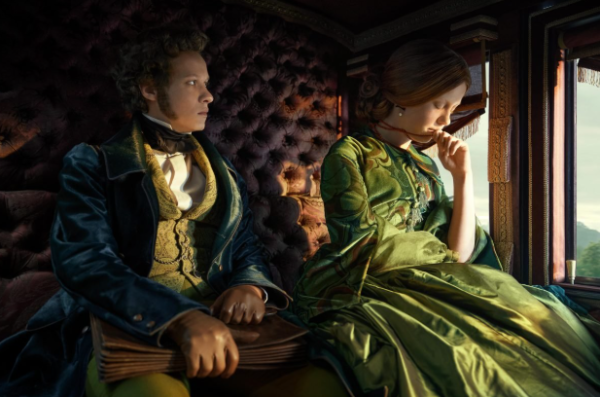
Guillermo Del Toro’s movie, Frankenstein (2025), has gained international popularity, ranking globally as Netflix #1 most watched movie for several weeks after its release and having since received five Golden Globe nominations and nine Academy Award nominations.. It quickly grew popular for its distinct creative direction and storytelling, of which we can see reflected in the costumes Kate Hawley created for the film, who additionally received her first Academy Award nomination for her work.
However, being a historical film, Hawley is challenged to balance historical accuracy with garments that tell a story and reflect the themes of the movie. The balance can be tricky, and leaning too far away from the time period often sparks controversy, but complete historical accuracy to the point of mundanity risks the loss of important storytelling information. Success is usually found in being historically informed about fashion at the time, and choosing to be accurate or inaccurate to serve the story the costumes are trying to tell. As one of the only focal female characters in the film, Elizabeth (played by Mia Goth) had a big job to do in representing womenswear of the era. However, Kate Hawley was up to the task.
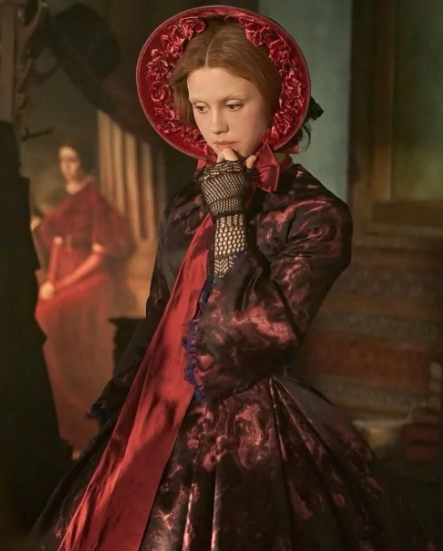
By dressing Elizabeth in gauzy, sheer materials and fabrics reminiscent of blood cells, x-rays, and beetles, Elizabeth’s costumes both stand out and fade into the background, as she does. She is related to both inanimate biological components and vibrant life, a paradox representative of her role as an opinionated woman in Victorian England who is pushed to the sidelines. But how does the history behind her garments complicate this view?
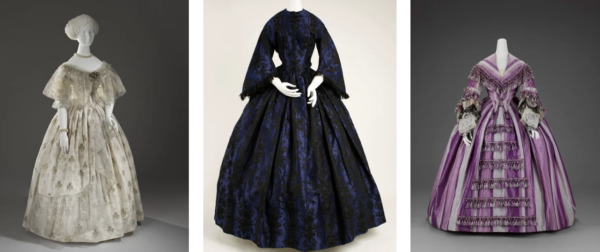
Hawley’s designs remain incredibly accurate to mid to late 1850s silhouettes, which emphasized low, sloping shoulders, fitted bodices with a small waist, and wide bell-shaped skirts. Hawley sticks so close to the fashion of the period that the costumes almost look like extant garments from the period.This classic mid-Victorian silhouette is present in all of Elizabeth’s costumes and helps ground her in the era. By paying such close attention to the history of the period, the movie feels more realistic and remains true to fashion and life of the past.
However, we can see a departure from history in favor of Del Toro’s signature colorful, gothic style in the choice of fabrics used in the garments. Kate Hawley states she “had real bits of malachite in the workroom” and “a whole collection of beetles in our studio to take inspiration from” for the fabrics. The bold colors are not out of the norm for the period, but the specific patterns and shades Hawley used are fantastical in nature and do work to separate Elizabeth from the other characters, and the setting, of the film. The characters stand out against the gothic, macabre background of the movie and feel alive in a way that other aspects of the film, such as background characters and even the monster himself, do not. Hawley also chooses light, sheer fabrics in a lot of Elizabeth’s wardrobe. Hawley states she was inspired by 1960’s femme fatales to dress Mia in her nightgown, and other sheer fabrics.
Another element of 1850s fashion that is noticeably absent from Elizabeth’s dresses is any kind of collar. In the majority of extant 1850s dresses, large decorative collars were used on bodices to emphasize the broadness of the shoulders, and therefore make the waist look smaller. These were most likely left out of the movie to highlight the Tiffany and Co. necklaces that Elizabeth wears throughout the film. Though the pieces are stunning, they do bring into question the ethics of having one of the only female characters in the film be a product placement, especially at the expense of historical detail. If the collars had been included instead of the necklaces, one could imagine that they could be used as further symbols in the garment–as a ribcage, beetle’s wings, or pair of lungs.
Another iconic garment from the film is Elizabeth’s malachite-inspired green dress. The dress is full of nature symbolism, and ties her visual and metaphorical image to the green-blue hues of the Creature’s skin. Additionally, Hawley plays with known historical silhouettes in order to make a point about Elizabeth’s place in the story at the beginning of the film in a way that she would be unable to do without first looking back at history. The dress has many elements of 1850’s fashion, but is more accurate to the 1840s because of the narrowness of the skirt, plain bodice, and sleeves that gather into cuffs. In the 1850s, dresses were fuller, including the skirts and sleeves. The crinoline was invented in 1856 to help create this silhouette, and was widespread by 1857 when the movie takes place.

Another iconic garment from the film is Elizabeth’s malachite-inspired green dress. The dress is full of nature symbolism, and ties her visual and metaphorical image to the green-blue hues of the Creature’s skin. Additionally, Hawley plays with known historical silhouettes in order to make a point about Elizabeth’s place in the story at the beginning of the film in a way that she would be unable to do without first looking back at history. The dress has many elements of 1850’s fashion, but is more accurate to the 1840s because of the narrowness of the skirt, plain bodice, and sleeves that gather into cuffs. In the 1850s, dresses were fuller, including the skirts and sleeves. The crinoline was invented in 1856 to help create this silhouette, and was widespread by 1857 when the movie takes place.
The choice to have Elizabeth wear a dress that looks like it belongs in the 1840s may have been done to show a progression of Elizabeth’s character throughout the movie. By placing her in a dress several years out of style, we get a sense of Elizabeth’s disregard for social norms and societal expectations around fashion at the beginning of the film.

Other historical details on this dress include the pointed bodice to create the illusion of a small waist, low-set shoulders, darts down the front of the bodice to create a fitted and smooth shape, and a closure in the back of the dress reminiscent of a spine (though front closures were also seen during the period, they were less popular and usually were seen in working class garments).
The shape of Elizabeth’s bodice, and gathering along the top of the skirt, in particular are very true to the period. The bodices were smooth, and padded, and tight, but not painful or overly restrictive, aiming to carefully craft a silhouette in line with beauty standards for women at the time which lauded wide shoulders and hourglass figures. Despite the dress being from ten years before the movie takes place, its adherence to historical accuracy works to make Elizabeth’s character realistic within the world of Frankenstein, and make sure the garment fits into the film’s setting without being jarring as it works to show Elizabeth’s character and represent how she would have been actually dressed in the time period.
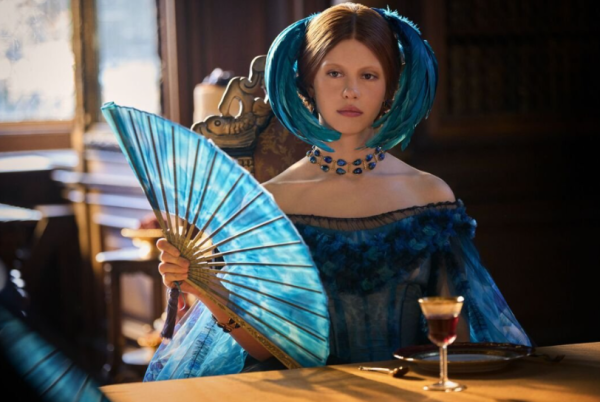
The blue dress Elizabeth wears at the beginning of the movie is possibly the most iconic of the whole film, with the highlight being the large feather headdress and bold colors. Again, Kate Hawley stays true to the silhouettes of the period, this time bringing in historical details from 1850s eveningwear. A low, curved neckline that exposed the shoulders and collarbone would be worn for operas, parties, and dances at night, along with shorter sleeves and bold headdresses.
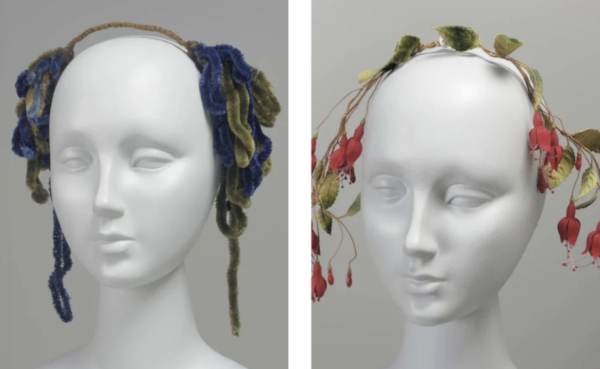
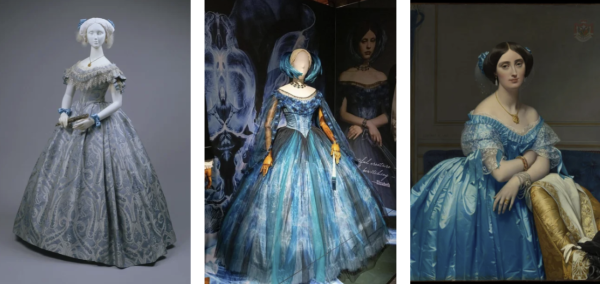
It is interesting, therefore, that Elizabeth wears this dress during the day, as it would have been seen as improper during the time period to do so. Along with the bold electric blue fabric and exaggeratedly large headdress, it makes a statement about her resistance to control, and disregard for social conventions. She stands out in this scene, and against Victor Frankenstein, in a way that highlights her importance in the rest of the film.
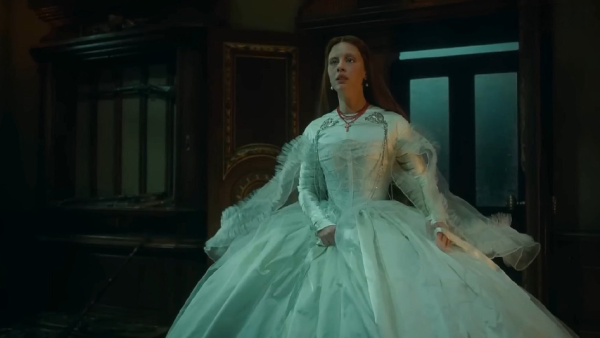
Elizabeth’s wedding dress is another memorable highlight of the movie. With wrapped sleeves reminiscent of both the Creature and the 1935 Bride of Frankenstein film, as well as ribcage bodice, the gown serves as a metaphorical and physical representation of Elizabeth’s tie to the Creature and separation from the world around her.

The gown is exaggerated and otherworldy—the skirts are wide in a way that would be more popular in the 1860s, the long, tight sleeves additionally make the gown seem “from the future,” and the gauzy fabric makes Elizabeth look like a ghost or specter. However, the rest of the gown looks like a typical wedding dress of the period in terms of silhouette, material, and style. As a result, Elizabeth seems to sit between times, out of sync with the story around her.
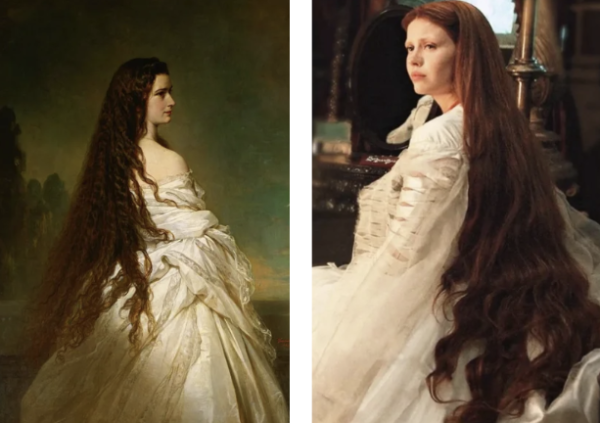
A notable moment from the film is a shot we get of Elizabeth sitting at her vanity, with her hair flowing down her back. This is a clear reference to Empress Elisabeth of Austria, nicknamed “Sisi,” who was known for her beauty during her reign and the portraits painted of her. Notably, having one’s hair down in public was seen as a faux pas in the Victorian Era, and would have been reserved for private settings and sleeping. It is fitting, therefore, for Elizabeth to have her hair done in such a way for a scene about a wedding that she is being forced into, and which strips her dignity away.
In conclusion, Kate Hawley is able to use knowledge about historical fashion to create costumes that tell a story about Elizabeth, and women of her time period, in a way that would be impossible if the history behind the garments was not considered. However, she also balances accuracy with precise deviations from history that serve to tell a story. Hawley’s use of history to convey ideas and make the story shine is a message to all costume directors of historical films; that history does not need to be foregone in order to create good garments for film. In fact, as seen in Frankenstein, using history to your advantage can make a movie truly unforgettable.
Emma Griffith • Feb 20, 2026 at 5:04 pm
A stunning article! I was struck by how beautiful the costume design was, and you covered all the details very well!