
The roar of the flywheels dies down as the emcee announces the winner of the round. FTC Team 5206 The Knights of Ni gets ready, each member of the pit crew preparing for their task, not on a track, but in the gym of Folsom Lake College. The Robotics team placed 9th overall in the qualifying matches out of 28 at the Folsom Qualifying Tournament #1 this past weekend where the pit crew had the crucial role of keeping the robot running smoothly between matches.
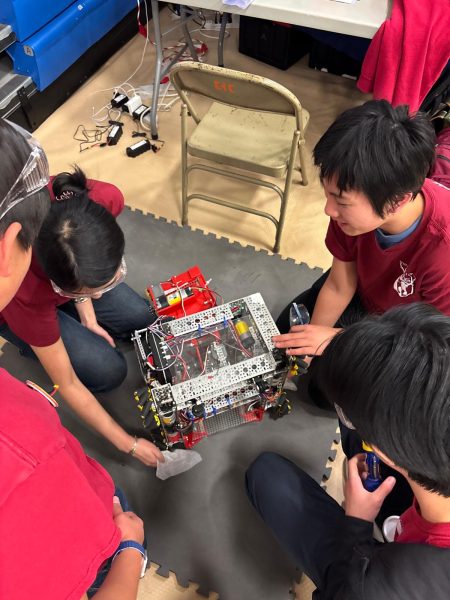
Dr. Kim Failor, Robotics Club sponsor and coach, notes that the robot rolls into the pit “with 5 to 10 minutes to get everything done before the next match.”
In those few crucial minutes before matches, execution, in order to gain control of the robot, is the main goal. There is no scope for trial and error.
What happens in the pit is rarely visible to spectators in the stands, yet it is where matches are made or broken before they even start. As the hardware lead of the team, Han Lu (’27) explains, “Our goal in the pits is to make sure that the robot performs well because we experience a lot of hardware or software issues that exist within the match but don’t really come up during practice.”
Someone checks the wheels. Someone else swaps the battery and replugs the camera. The robot is wiped down carefully with a dryer sheet to remove extra static. A strategy is whispered over the loud noise of teams working together between the two alliances. Every member, even if they are not on the drive team, is hard at work with their integral tasks. With a situation so similar, you would expect to hear songs from F1 The Album, but all the noise is drowned out to a focused flow state.
“The design of the game just invited more problems, so we had to be sure to hit a lot of things. Since there were a lot of steps, the checklist seemed like a good method of keeping track of everything that we needed to do before competing,” Lu says. Each task, though small, culminates together to determine whether the bot has any chance of supporting the alliance partner and defeating the opponents.
Time lurks in the background as the team attempts to hit all the elements of the checklist. During the qualification matches, while there is sometimes room to improve by adjusting the autonomous code or squeezing in an extra driver practice, during the playoffs the pit stop becomes what Lu calls, “a race against the clock.” He says, “We have less time; we just do the basic maintenance stuff instead of trying to make the bot more reliable.”
Robotics team members perform various roles and tasks during a competition. They run to get batteries and extra zip ties, secure practice slots, and communicate between the pits and the queuing tables.
“Members are running the various errands that are not related to operating or maintaining the robot… that’s really important, but it usually goes unnoticed,” says Lu. “There’s a lot of chaos that goes into making sure everything works, especially when you’re in a time crunch and the queuer is telling you to line up.”
At the tournament, Lu recalls that the team had around two to three minutes to rewire all the batteries while they were already at the queue table.
While Lu focuses on the execution, Failor watches from a broader angle, noting the trust, communication, and small interactions that make the time in the pit successful. “There’s a lot of double- and triple-checking,” Failor says. “Someone is listening for announcements, someone is keeping track of time, and people are constantly asking questions to make sure nothing gets missed.”
The situational awareness, she mentions, is built long before competition day. “A lot of what makes the competition run smoothly happens before the event,” Failor says. Without that foundation of trust and understanding, the pressure would fall on a few people instead of being shared across the team.
After both good matches and bad ones, the pit becomes a point to reset. “You can’t let a bad match linger,” says Failor. With new alliances and new opponents every round, morale and emotional support become part of the strategy.
Overall, the pits of a robotics competition take on a similar function to that of professional motorsport racing, where timing, decisions, and teamwork are crucial, though the stakes are different.
Failor says, “When I think about swapping out the tires on the car, the parallel would be swapping out the red and the blue alliance markers on the side of the robot. Which alliance we are on determines which auto code we would have enabled so that we are pointing in the right direction. The team makes sure to swap out the code so that they have got the right code loaded up on the robot.”
Failor laughs when she recalls a new task the team took on at this tournament.
“The rubbing down of the robot with the dryer sheet to remove static charge reminded me of polishing up the car,” she says. “It was about making sure everything was in tip-top shape, peak performance mode.”