
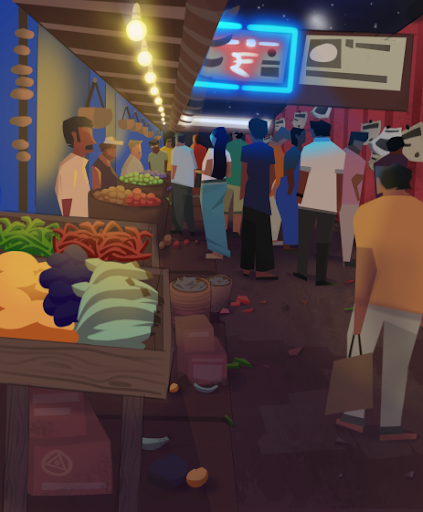
I smell frying samosas, as devotional music competes for attention with people talking loudly in Hindi, Telugu, Tamil, and Gujarati. A stray coriander leaf lays on the floor like that’s its hometown. Indians bustle around the grocery store in a manner akin to bazaars in India. With the frozen dosas, idlis, and parathas in the background, I am in the midst of the cultural microcosm that is the Indian grocery store in the United States
Immigrant stores like these offer not only food and other goods from the home country, but also a sense of home for buyers. These stores’ identities, however, much like the identities of their immigrant founders, have been in flux. Until more recently, “Asian market” was a catch-all term for stores that carried Korean, Chinese, and Vietnamese goods. The rise of transnationalism has created an exponential rise in hyperlocal, yet hybrid, identities which resist the previously singular blanket identity imposed on them earlier. While people themselves resist being relegated to homogenous categories, there are still stores that house variegated identities under one umbrella. “African” markets are one such example.
In his article, “Cultural Identity and Cinematic Representation,” Stuart Hall emphasizes the importance of the points of divergence in cultural identity between communities. While acknowledging similarities are important–such as the shared identity of being Asian–a conception of identity can only truly be formed through the admission of difference. For communities, especially those that are marginalized or were colonized, the ever-morphing state of identity births an urge for cultural markers that render parts of their identity immutable.
Because America is often defined as a place of refuge for the displaced who struggle with a clawing sense of loss, the need to integrate into the larger culture lives in parallel with a deep desire to regain what has ceased to exist. Hence, cultural identity is often defined through food and religious and traditional customs that are immune to geographical itinerancy.
Establishments such as boba cafes, Korean stores, and Indian grocery stores in the US create communities that are tied together through not only their customers’ desire to buy food redolent of home, but also through the community that is created in the shared experience of the diaspora. Through these physical spaces, in whatever limited way is possible, a sense of home is reinforced. An example of this is fresh food counters, reminiscent of open-air bazaars in South and Southeast Asia. Markets sell comfort, a connection to culture, thereby transforming into safe spaces, both physical and emotional.
Increased immigration has fueled the rise of specialized restaurants and grocers in cities where these immigrants are clustered. A case-in-point would be immigrants from the Indian subcontinent in California. This dynamic has led to increased diversification and more granular cultural distinctions within the realm of grocery stores. In a place such as India, where each state has a distinct culture and customs, this diversification legitimizes their distinct identities. Likewise, where “Thai cuisine” was a catch-all term for Vietnamese, Laotian and Thai food, there are now restaurants specializing in the cuisine that distinguish between Northern and Southern Thailand. “East Asian” has diversified with Korean, Thai, Vietnamese, and Chinese stores popping up.
There is a lot to glean from the tiny, musty stores that encompass entire identities. In the dusty aisles, you can often find a version of a country from the 70s or 80s that has ceased to exist in the home country. Moments hang in the air, frozen, and fractured, mutable identities find a home and safety in the low hum of familiar language and smells.
Note: Thank you to OHS student Stephen Djata ‘26 for the wonderful art.