
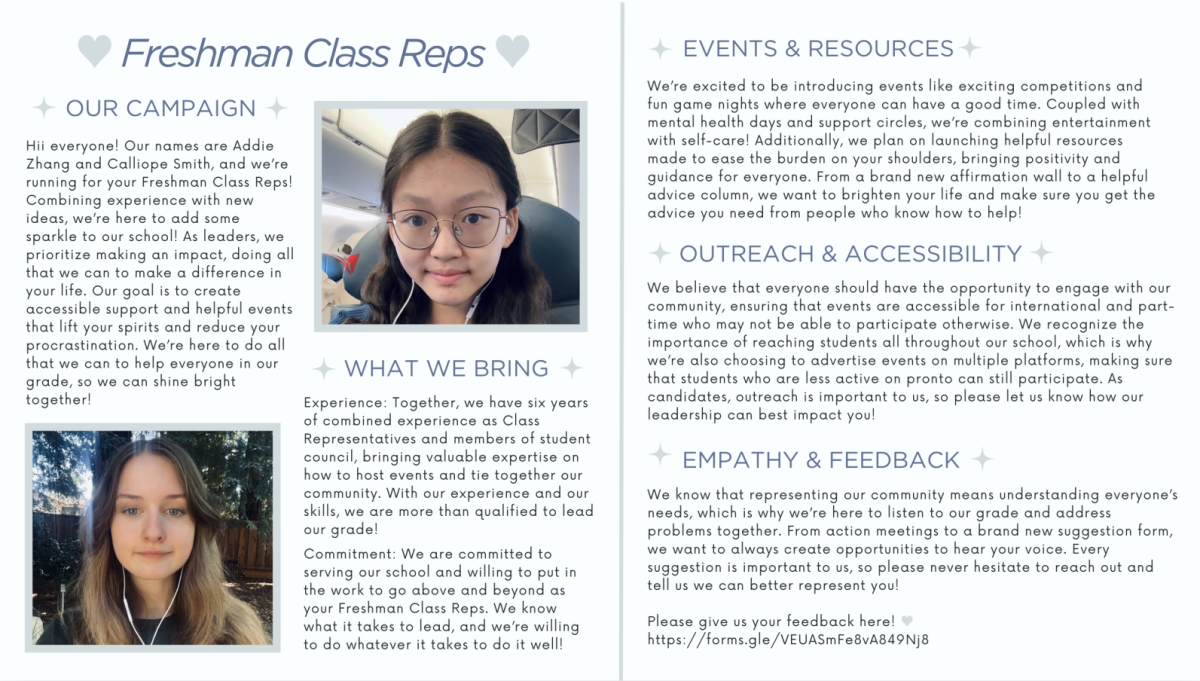
We are all familiar with the beginning of the first semester of school: getting to know new teachers and friends, navigating new classes, and being inundated with student election campaign flyers and promotions. While these school elections happen yearly, rarely do we pause to ask questions about the legitimacy of the voting and election process. Do students really vote for policy, or are their votes based on popularity? Considering how much of a boost being a leader in student government can provide to college applications, and more importantly, how much leaders influence the experience of school for the entire student population, these are important questions. In a recent poll, OHS students responded.
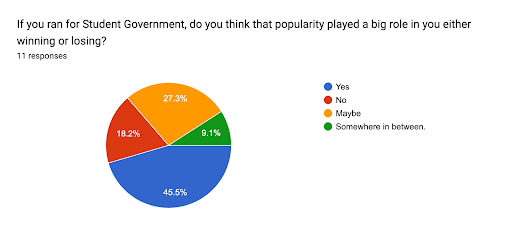
81.9% of students feel that popularity, in and of itself, had some influence, at least on the outcome of this year’s elections. In more concrete terms, among those who were 100% sure of their response, 45.5% said “yes, popularity did play a role in the outcome of the election,” while just 18.2% said that it did not.
In response to the above statistics on popularity possibly influencing student elections, Pete Demyanovich, Director of Student Life, said, “What I think is most important is that Student Life absolutely not ‘put their thumb on the scale’ for any candidates by providing something different for certain individuals but not others. Demyanovich adds, “In helping facilitate SG elections, Student Life aims to provide the same platforms, outlets, opportunities, and avenues for every candidate to get their message and campaign ideas out there.”
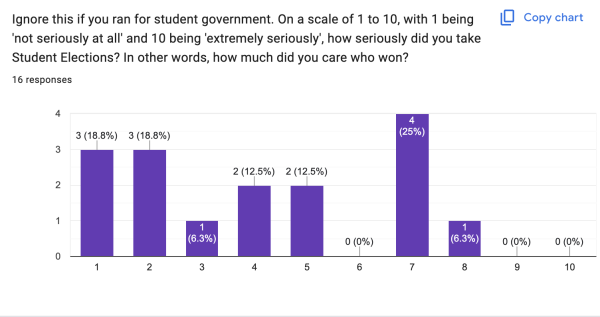
There is also a question of how seriously students take student elections and whether voters take student elections as seriously as candidates do. For example, during election season, we see abundant messages in Pronto promoting student campaigns, suggesting that candidates put a massive effort into advertising. In comparison, when asked to rate how seriously they take student elections on a scale of 1 to 10, only 31.3% of respondents rated 6 or higher, indicating that they take the election seriously, while 68.9% rated 5 or lower, indicating a moderate level of seriousness. A sizable 37.6% voted just 1 or 2, indicating that they don’t take the elections very seriously. Only 6.3% of respondents indicated a very high level of seriousness.
In an effort to help students take elections more seriously, Demyanovich said, “Student Life can and should work more closely with Student Government to regularly highlight how Student Government impacts the school. We will continue to work hard to communicate when elections are happening clearly, how students can make a change at the school, and ways all students can make a positive impact, whether they are elected reps or not.” Demyanovich adds, “Our elected reps have a major role in helping convey how elections impact their classmates. This might help encourage students to take the elections more seriously.”
The impact of student government is also controversial, and is an aspect that influences how students perceive the value of the student election process. For example, one student said, “It seemed like a very shallow thing to participate in since the only people who benefit from SG are the elected candidates. SG elections are, in essence, a superficial popularity contest in which contestants profess to care about the student body in hopes of scoring a couple of sentences to put on their college applications. I think most students would agree that SG doesn’t accomplish anything of substance or have any tangible impact on them.”
However, poll results reveal positive attitudes surrounding Student Elections at OHS, especially regarding voters being well-informed and candidates seeming genuine. For example, of students polled, only 4% indicated that they voted for their chosen candidate “because they were the most cool/popular,” which suggests that many also considered what the candidate had to offer, creating opportunities for the “less popular” students at OHS to win.
Candidates express that they have a genuine passion for serving their school community, and aren’t motivated solely by the ability to add another extracurricular to their college application.
“I ran for Board Chair of Arts because I am really passionate about the arts,” says Inaya Dar (‘27). “I wanted to support student artists and to help make the arts more prominent in our community. ”
The desire to enrich the student community at OHS is shared by candidate Karina Solodova (’28). “I ran for sophomore vice president because I wanted to make the class of 2028 more lively and Brick and Mortar-like. I also wanted to gain experience in leadership and communication.”