
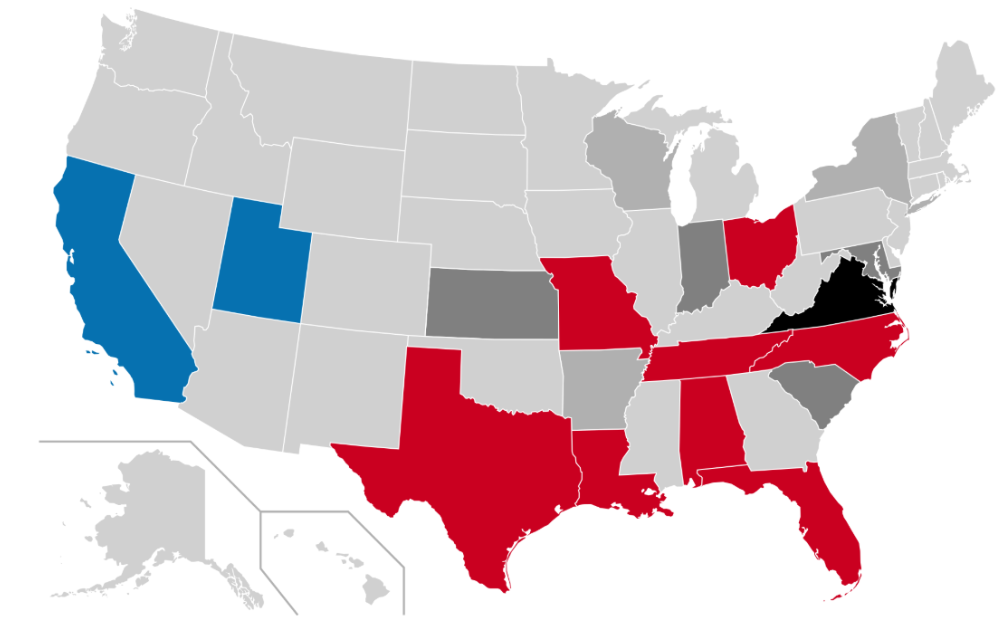
Gerrymandering has been a controversial issue in American politics since the founding of the nation. It occurs when a state deliberately alters its congressional districts to favor one party over another. Even as early as 1788, a candidate altered district lines to prevent another from winning a congressional seat. However, in the run-up to the 2026 midterm elections, which ultimately decide which party controls Congress, there have been numerous instances of both Democrats and Republicans gerrymandering congressional districts to benefit their own parties.
Both parties have unfairly gerrymandered numerous states even before the current mid-decade conflict. For example, Wisconsin has been closely divided in recent presidential elections. There has been an almost 50/50 split between Democratic and Republican voters. Despite this split, Republicans approved a congressional map that would enable them to hold six congressional seats, leaving only two Democratic-leaning seats. This resulted in a 75/25 split, which is disproportionate to the voting patterns of Wisconsin voters.
Similarly, in North Carolina, an almost 50/50 state, North Carolina Republicans redrew their congressional map to favor themselves, creating eleven Republican-leaning seats and just three Democratic seats, giving Republicans about 79% of the seats.
Similar to Republicans, Democrats have also engaged in gerrymandering. In Maryland, which is about 60% Democratic-leaning and 40% Republican-leaning, district maps created seven Democratic-leaning seats and just one Republican seat, turning the ratio to 87.5/12.5. Likewise, similar gerrymandering has occurred in Illinois. The state is also a relatively divided state with about 55% Democrat vote and 45% Republican vote in the 2024 Presidential Elections. Despite this, the Democrats created a congressional map with fourteen Democratic-leaning seats and just three Republican-leaning seats, giving Democrats about 82% of the seats.
Despite both parties deliberately gerrymandering their own state maps for many years, the most recent, large-scale conflict occurred in 2025, when President Trump urged Texas Republicans to redraw the state’s congressional map. The outcome was that the Republican-controlled legislature created a map that gives Republicans a five-seat boost in Texas. Other Republican-controlled states, such as Missouri, North Carolina, and Ohio, redistricted their own states, soon after Texas, to favor Republicans.
Democrats responded with other actions of their own. For example, California, a Democrat-controlled state, retaliated by approving Proposition 50 in November 2025, barring the nonpartisan California Citizens Redistricting Commission from drawing congressional maps for the remainder of the decade. This proposition also gives Democrats a five-seat boost. After California, the Republican-controlled Florida legislature passed its own congressional map, giving the Republicans a four-seat boost. Other Democrat-controlled states, such as New York and Virginia, have also been trying to redistrict as an attempt to gerrymander, though these were struck down in the courts. Overall, these retaliations cause further retaliations, which have the potential to cause a never-ending retaliation battle.
In a major ruling in April 2026, the United States Supreme Court ruled to dismantle many parts of the Voting Rights Act, which had historically emphasized that districts drawn had to represent African American voters. This meant that the states, particularly in the South, were required to create districts that gave minority voters, especially African American voters, a meaningful opportunity to elect candidates of their choice. Now that these Southern states, such as Louisiana, Georgia, and Alabama, which are usually controlled by Republicans, do not have to comply with that rule, many are attempting to eliminate districts with majority African American populations. This could eliminate up to seven majority-Black districts, reducing representation of minorities in Congress. This could also mean the Democrats might retaliate in their own states, ramping up an already tense situation, just a few months before the 2026 midterm elections.
Gerrymandering creates an inaccurate representation of congressional seat counts compared to what the state really wants. It undermines representation because it allows politicians to choose their voters rather than voters choosing their representatives. One proposed solution is the use of independent redistricting commissions. States such as Michigan, Arizona, and Colorado already have bipartisan commissions to draw district maps. These commissions create fairer and more competitive districts while reducing political manipulation. Voters can actually be heard, rather than being disenfranchised by political parties. The United States would likely need to sign a federal law mandating independent redistricting for all states. This could be a challenge since neither party seems to want to fully cease gerrymandering in reality. The solution is clear: all states should adopt independent redistricting commissions if Americans want fair elections in the House of Representatives and other district-based elections.