
I never would have expected a simple 16-count rhythm to be the one that fascinates me most. Through countless small projects from my dance teacher over the past 11 years, for me, the 16-count system has become a puzzle much like the Kanoodle. A puzzle that has countless possibilities to form new thehais (rhythmic patterns, called pallas, that repeats itself 3 times). Not only within the large number of possibilities of how you break up a single 16-beat set, each mini third within it has endless possibilities of how it can be choreographed.
To understand this flexibility, one must look at the mathematical problem of fitting three identical rhythmic patterns into a fixed total number of beats. Since the total number of beats cannot change (unless you add another cycle), any variation stems strictly from how the beats and the gaps between the patterns are distributed.

I have learned that you can break it into a 5-5-5 pattern with a 1 beat gap between the first and second sets as well as the second and third sets, to end back on the 1st beat.
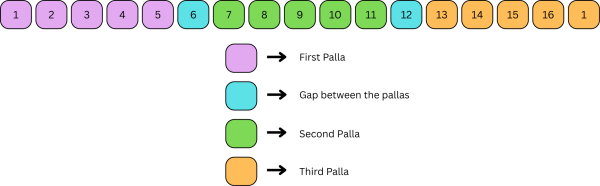
In this thehai the pallas themselves never change, but rather the placement of the gaps allows the entire composition to end cleanly back on the first beat of the cycle. The same numbers can produce a completely different thehai depending on what beat in the cycle the thehai starts on. Instead of splitting the extra two beats into two one-beat, to develop another composition, the entire thehai can start on the second beat, allowing for the extra beat to be split into two ½ beat gaps.

After understanding a single 16-beat cycle, the variation of the starting position brings in even more complexity. In my dance company, we learn and dance the “Natawari Thehais.” This is a set of 14 thehais that each start on a different beat in the 16-beat system.
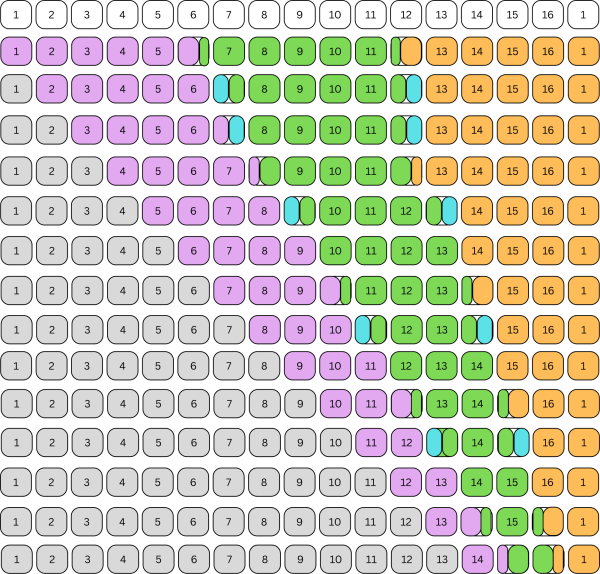
Each row in the graphic represents a different thehai. The gray area shifts progressively to indicate later starting beats in successive rows. Each small change in the starting beat leads to entirely different thehais being produced. (Note: these are just the groupings and gaps we use, there are a multitude of other possibilities!)
A thehai need not be only 1 cycle long, one can also have thehais that are 2 cycles or more.

Although the 16-beat system is one of the more common ones as it is very beginner friendly, there are other n-beat systems such as 11, 7, and 5.5, each with unique patterns.
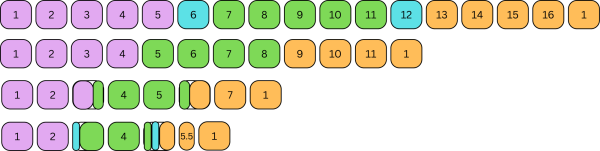
Each n-beat system uses a different pattern of breaking up the beats, where some divide very cleanly while others rely heavily on fractions, going beyond a simple ½ fraction to something as small, but important as a ¼ fraction.
From composing my own thehais and compositions in each system, I have started to appreciate how deeply mathematics is intertwined with art forms – music, dance, nature etc., pushing past connections taught in class. Whenever I am trying to compose my own compositions, I often find myself turning back to the basics of mathematics and computation, like division, fractions, loops, and nested loops. I turn to math first because it gives me a clear structure to work within, helping me organize my ideas before having to translate them into movement. When I had to compose my first three-minute piece on my own, I remember sitting on the studio floor, unsure where to begin. Instead of jumping straight into choreography, I started by calculating the number of 12-beat cycles that would fit into three minutes at 56 beats per minute, a tiny moment of dimensional analysis that got me started on the project. Once I knew the number of cycles, I could assign different sections to each thehai and then shape the movements to match their lengths, and that is when the ideas started flowing. When I want to learn more, I always turn to numbers & computation, whose patterns always reveal something new.