
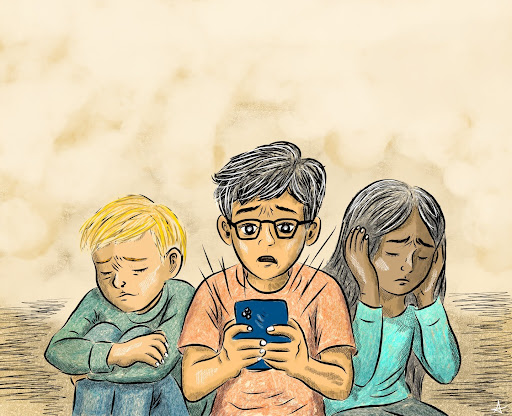
The internet has a way of throwing things at you that you’d rather not catch. You’re scrolling through what should be harmless, silly memes and suddenly come across a violent video. It’s something you didn’t ask to see. But now you just can’t erase it from your mind. It’s jarring, a bit like a horror movie scene you can’t seem to get out of your head. “I see dead people!” Well, thanks, Cole! Now I see them in my nightmares too!
Social media platforms don’t help either. But then again, they were built to keep you hooked, not to keep you safe. Autoplay doesn’t ask your permission for playing a nasty video, and the algorithms don’t care about your mental health. In recent years, with even fewer human moderators and more responsibility pushed back on the users, it can feel like you’re caught in a flood.
The problem is becoming more challenging because our media consumption has shifted from few interactions to everyday scrolling. Also it is the children and teenagers who are coming across more violent and graphic content online, even if they don’t actually seek it out. This could be happening because teenagers and younger kids are heavier users of social media sites, but then it could also be the result of changes in these companies’ policies about content moderation and the slip-ups or errors in their filtering algorithms.
In February 2025, Meta apologized after a bug in Instagram’s Reels algorithm filled some users’ feeds with disturbing and unsettling images. But then, even when they are working perfectly, these algorithms are actually designed to maximize engagement. To do this, they often aggressively promote content that causes shock or outrage. This is the reason why excessively violent videos, extreme pranks, and hate speech are amplified rather disproportionately as compared to the more neutral or more informative posts.
These frequent exposures have normalized the content that a decade ago would have been considered unusual or “weird.” This gradual shift has happened because social media has fundamentally altered the norms which used to determine what was suitable to watch, share, or even laugh at.
Researchers have found that this normalization can dull empathy and raise anxiety levels, especially amongst younger users whose worldview has not yet fully developed. Studies have proven that exposing yourself to disturbing stories or images repeatedly can actually significantly increase your stress levels. Controlled experiments demonstrate that individuals who repeatedly watch violent clips often become less emotionally reactive over time. They rate violent content as something that is more “entertaining” than shocking, and also report lower levels of sympathy for victims. However, repeated exposure doesn’t always result in numbness. When such kind of content is connected to actual tragic events, it can also result in people experiencing increased levels of stress, anxiety, or even symptoms of post-traumatic stress disorder.
What we must remember is that we’re allowed to look away. Choosing not to watch something scary or disturbing isn’t cowardice, but a form of protecting your mind. There are practical defenses to protect yourself from disturbing trending videos. These tactics may seem small but, cumulatively, not insignificant.
Turn off autoplay. Use the mute and block functions, even if it feels silly to filter words out of your timeline. Follow the people who bring you inspiring thoughts or positive ideas, not dread and anxiety. It doesn’t have to be preachy, it doesn’t have to be academic-oriented news articles either. It could be just videos of cats being cats. But then don’t let them intrude on your meal times. And maybe music or a book before going to bed? These aren’t grand gestures, but they do add up.
The future will likely bring new, tougher challenges in channeling our social media interaction positively, but it will also bring new tools to protect us against harmful exposure. With features like blurred previews and trigger warnings designed to give users a choice before watching, advances in artificial intelligence are already being used to detect violent or graphic content. Personalized safety filters, where users can set preferences to reduce exposure to violent or self-harming content, may be made possible by more advanced AI.
AI may also be able to detect when users are being lured into “rabbit holes” of progressively unsettling videos and take action by diversifying the feed or reducing the speed of recommendations. But there are still risks. Algorithms may underfilter because of financial incentives that prioritize engagement ahead of security, or they may overfilter and censor harmless content. Another level of complexity is introduced by cultural bias in the definition of what is considered “disturbing.”
The undeniable truth is that social media wants your outrage, your reaction. It feeds on your shock. But your attention is yours to give. Every time you draw a boundary, you get back a little bit of yourself from the continuously updating, unending feed filled with violent acts, unpalatable pranks, and everything else that can be categorized under the unbridled need to feed off another’s shame or misfortune.
Every little bit of effort to set boundaries matters. Not just so you can keep breathing calmly, but so you have the energy left over to care about the things, issues and people that actually matter.