
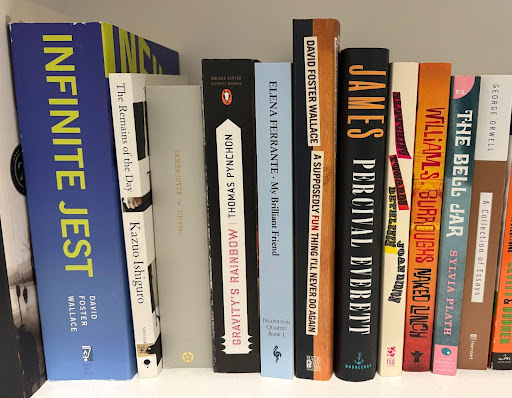
David Foster Wallace, in an interview with German public television station ZDF, once said something that I think about often: “There’s a lot of narcissism in self-hatred.” It’s one of those quotes people like to keep filed away on Tumblr dashboards, tucked in one’s back pocket of platitudes, captioned beneath a carousel of selfies as if Wallace were less of a writer and more a minor god of disaffected American feeling.
Still, when I first read it, I felt physically jarred, like someone had just turned a bedroom light on. I had been sitting cross-legged in my bed, mid-scroll, wrapped in the particular brand of depressive self-involvement that passes for introspection when you’re sixteen and have spent the past three years outlining a diagnostic narrative for why you are, in fact, a bad person. When I saw that sentence on my feed—there’s a lot of narcissism in self-hatred—it hit like an insult, like being called out by someone who’d been watching.
I knew immediately that it was true. True of me and true of people I loved, especially the brilliant ones.
There’s this girl I used to be close to, N. She was the sort of person who you knew would go Ivy from the moment she learned how to use a semicolon. Her entire life read like a parody of a successful teenage girl. Model UN co-chair, political TikTok side account, private therapy since fifth grade. She kept a handwritten list of every time someone told her she was intimidating. The last time we talked, she told me she didn’t think she deserved to be alive. But she said it like she was daring me to disagree.
What strikes me about people like N, and what struck me even more after reading Wallace’s quote, is the way self-hatred becomes a performance. I don’t mean that it’s not real. I mean that its reality is shaped by the style in which it’s expressed. Self-hatred is almost never quiet, at least not in the world I live in. It’s published across platforms, woven into jokes, tweeted, confessed, turned into art, into pathology, into proof of perceptiveness. It shows up in bullet-pointed Discord rants and carousel posts captioned “just being honest.” It shows up in close friends stories and in private Instagram bios that say “if I’ve ever hurt you I’m sorry.” We have created an entire semiotic structure in which declaring yourself to be broken is indistinguishable from asking to be seen as good.
And the thing is, it works, and it works beautifully. The performance of self-hatred—the sigh-laced disclaimers, the compulsive overexplaining, the preemptive admissions of guilt—they are made socially legible and in turn morally persuasive. To say “I’m terrible” is to beat others to the punch, to own the insult before anyone else has a chance to land it, and in doing so, to turn it into something like a virtue. It functions as a defense against accusation. No one’s going to call you manipulative if you’ve already done it yourself, in a series of texts sent at 1:13 a.m., complete with timestamped examples and a rhetorical bow: “I’m working on it.”
But beneath all this cultivated rawness, this promise to work on oneself, there’s a kind of pretense. The girl who says she’s a terrible friend is rarely trying to become a better one; she’s trying to narrate the guilt before anyone else can use it. The boy who says he “can’t stop hurting people” doesn’t necessarily want to stop; he wants you to know that he knows. There’s a strange power in being the first to flay yourself in public, one that acts as a kind of self-absolution, even if unsaid.
I know this because I’ve done it, constantly. I have this awful habit, this defensive tic, where I’ll confess something ugly about myself in a tone that begs the listener to be impressed. I’ve said “I was kind of horrible to him then, honestly,” with a level of self-satisfaction that should’ve made me gag. I’ve admitted to jealousy, pettiness, performativity—whatever you want, I’ll say it. Just let me say it first, and I’ll never have to be accountable in silence.
And I wonder—more than wonder, I suspect—that this whole mechanism, this meticulous self-surveillance, is what we’ve come to substitute for moral action. We become connoisseurs of our own damage, able to distinguish a narcissistic injury from a codependent spiral with the precision of sommeliers. We want to be the kind of people who can name what we’re doing wrong. But if your entire self-concept depends on being broken and aware of your brokenness in just the right way, what happens when you start to get better? Who are you if not the tragic genius of your friend group, the boy who breaks hearts but “feels bad about it,” the girl who sends long voice notes parsing “avoidant tendencies” instead of showing up to the party?
I think getting better often implies ordinariness, and the fear thereof is what this whole behavioral paradigm rests on. Being not-hated, not-dysfunctional: we fear this more than we fear genuine self-destruction, because it implies that there’s nothing particularly wrong with us. And if there’s nothing particularly wrong, then there’s also nothing particularly compelling. You become a body that does homework, texts back on time, has a reasonable relationship to sleep, and a highlights tab that doesn’t read like a trauma résumé. You become, in other words, unthematized.
It’s what we’re all running from, this slow suffocation of ordinariness. There’s no aesthetic crisis in being okay, no literary flair to balance a week of banal emotional hygiene. You have to sit with the fact that your life, like most lives, will not be footnoted. You will not be excerpted in a stranger’s college application essay, or remembered for your collapse. You’ll most likely have boring problems with boring answers. There is a crushing absence of spectacle to most of our lives, and we do everything in our power to fill that absence.
I include myself in this. I’ve hoarded my guilt like it might one day pay rent. I’ve been told I write well about myself, and taken it, quietly, as proof that self-loathing is the only thing I’m good at. But I’ve been trying, lately, to write toward silence, and toward the possibility that maybe it’s okay to feel bad and say nothing. The real work is in being someone who is kind, not someone who can beautifully explain why they’ve failed to be.
I think Wallace was right, and I think we already know it. We know that there’s a lot of narcissism in self-hatred, and we do it anyway, because it gives us a shape. But I’m starting to think that letting go of that shape is the first honest thing you can do. And I’m starting to believe that freedom from self-hatred might begin precisely there: not in loving yourself, not in fixing yourself, not even in forgiving yourself, but in no longer needing to make yourself the subject at all.