
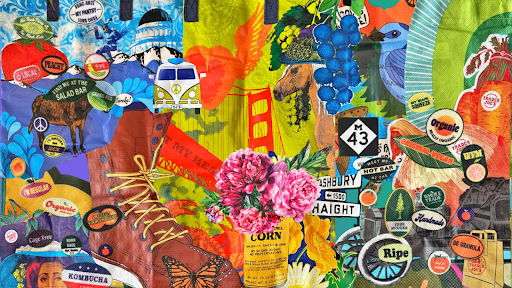
To date, I own 56 (and possibly more), reusable grocery/tote bags made by Trader Joe’s and Whole Foods Market. I like to tell my parents that reusable grocery bags are our family’s version of fast fashion. But taking the term “fast fashion” by its definition, that is not what I mean to say at all.
As defined by Vogue magazine, fast fashion refers to the “quickly produced trends sold at low price points,” characterized by its “way of manufacturing, marketing, and selling clothing.” This method of production and sale is what makes fast fashion infamous: an environmentally-dangerous supply that exceeds consumer demand, causing textile waste and exploitation of workers.
In our constantly progressing and competitive economy, being “backwards” or behind in the race is the worst crime for a business, country or individual consumer. Being “last season” has long been an insult for those not up to date with the latest fashions, a term that accuses the victim of outdated styles and irrelevance. Just think of Enrique–“the pool boy”–and Elle in Legally Blonde (2001). Buying luxury items (especially the most recent models) is a display of status and competence in the market.
One of the best (and most recognizable) ways status and privilege are displayed is in luxury handbags. The market size for the handbag industry was estimated to be worth USD 74.33 billion in 2025 and is predicted to have a 5.25% compound annual growth rate, making the market worth USD 101.06 billion by 2031.
The handbag industry reaps immense profits, but at an environmental cost. The making of a single handbag leaves a median carbon footprint of 11.78 kg (26 lbs), while the fashion industry in general produces 92 million tons of textile waste per year. China generates around 22% of it, while the U.S. creates 18%.
A large portion of this waste comes from consumers and businesses throwing out old clothes and textiles. The average U.S. consumer wears an article of clothing 7-10 times before discarding it, tossing out 81.75 lbs of clothes a year. The lifespan of a handbag (1-5 years) is much longer than that of an article of clothing. Bags are not always thrown out, but shelved, stored away unused when a newer, more desirable model comes out.
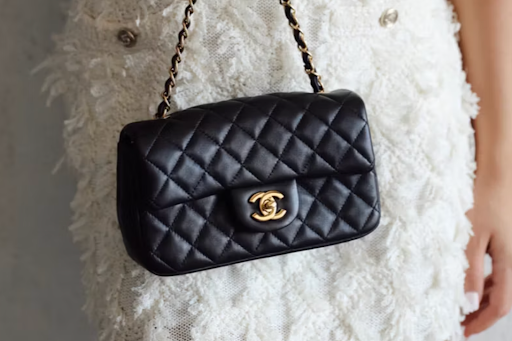
But are new models even that desirable? Luxury bags can be very impractical in size, price and quality. As CNN wrote last year, luxury goods made by brands like Miu Miu are sold for thousands (with one example of a customer spending USD 18,000 on two items), only to fall apart after their first use.
None of this is revolutionary information, and many articles have been written on this subject. So what is the point of this one?
Friends and fellow beings, I present Trader Joe’s and Whole Foods Market’s reusable grocery bags, the antithesis to the wasteful luxury bag industry.
Made as an alternative to the boring disposable grocery bag, these gorgeous reusable totes have become the environmentally-friendly replacement of their plastic counterparts.
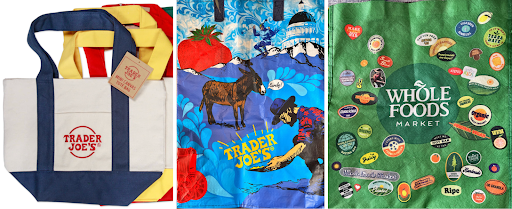
Trader Joe’s Canvas Tote Bags (left) are made of a blend of 65% cotton and 35% polyester, while their reusable grocery bags (center) are made of 100% polypropylene, which, according to ScienceDirect, is a recyclable thermoplastic polymer. Whole Foods’ reusable grocery bags (right) are also friendly to the environment, as one glance at their inside tag shows that they are made up 100% by recycled plastic bottles.
As a person who is constantly traveling, I have accumulated a large collection of Trader Joe’s and Whole Foods totes and reusable grocery bags. They have seen me through many long drives and hotel stops. They are big enough for packing for a beach trip, small enough to carry snacks, sturdy enough to carry books to and from the library, and of course, are ideal for groceries. They have so many uses, and I am always finding new ones.
They are not only pragmatic, but creative. Colorful, quirky, covered in collages of talking animals, plants, Victorian people (in the case of Trader Joe’s) and food. They are masterpieces of eccentricity, the tote bag for the eclectic fashionista.
This is what fashion should be, though I admit I know nothing of what fashion should be as an art. But I do know what it should be as a lifestyle: durable, sustainable, wildly creative and (though this is controversial) practical.
As a consumer I should be able to love looking at my purse or tote while also being able to put my phone in it, and if possible, the book that I should have left at home – but always bring with me, just in case.
Trader Joe’s and Whole Foods are always adding to this supply of practical but beautiful grocery bags, with both stores entering into a sort of rivalry by producing a series of state bags, a bag designed for each U.S. state. Trader Joe’s adds to the hype by selling these bags in mystery packages of three during the holiday season.
Are Trader Joe’s and Whole Foods playing to our desire as consumers to “collect each one”? Of course. But is it fast fashion? No. Their reusable tote bags, unlike seasonal luxury bags, are not meant to be discarded or shelved when a new design comes out. They last, and are designed to be used for everything.
By buying reusable bags (or in my case, 56 of them), meant to endure and be used for a long time (not till next season), the public provides an incentive to corporations everywhere to make products out of recycled or recyclable material. We need to change our habits in order to change a global lifestyle.
(Emma Griffith)
And I am not alone in thinking this. Worldwide, consumers, especially Gen Z ones, are changing their purchasing habits, moving from retail (a market with brand-fixed prices, like Gucci) to resale (eBay). Instead of encouraging mass production and fast fashion by buying products in store, consumers have started buying used, second-hand versions of products online or in thrift stores, decreasing incentive for new manufacturing and new waste. Because of this shift, the resale market size is expected to increase from USD 73 billion to USD 700 billion by 2030.
The Trader Joe’s Canvas Tote Bag itself, while not a representation of resale habits, has become a global status symbol. What you buy does identify you, and corporations and young consumers are starting to work together to produce an identity we can be proud of. Making a shift towards higher quality, lower cost (environmentally and financially) products is befitting of a generation that is making vintage cool again. If Gen Z and reusable grocery bags can turn the tide, maybe “backwards” will become the new “new,” and “last season” will become the highest compliment, not an insult.
Tom Martin • Mar 16, 2026 at 2:48 pm
Totally amazing article written by Ms. Griffith. I was hooked completely while thinking about our own bags from mostly TJ’s. You hit the nail on the head. This article was so well-written and taut, and full of great information. Keep it up!