
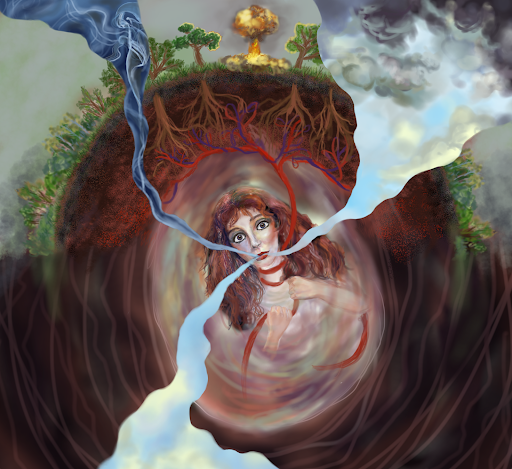
What is so special about the connection between life and death? It has induced philosophers to spend their whole lives thinking, has sparked countless existential crises, and has provoked Kate Bush to write a canon of songs that reverberate the cries of those who breathe in life, dance with death, and bend mortality.
1. Waking the Witch
“Waking the Witch” sets the listener into the perspective of a woman trapped underwater, hallucinating herself as a witch on trial in Salem, Massachusetts, 1692. Starting with a dream-like quality as soothing voices try to wake her up, they are sharply intercepted by her distorted pleas. The song layers disoriented sounds, swinging between mystic church bells and the tense synth of a crowd chant, making the woman’s witch-trial feel more real than a documentary. Against a festively eerie sea shanty and echoing arrays of Latin prayers, the accuser whips her with his harsh, cacophonous voice. Even after the woman’s spiraling cries reach the surface, a helicopter signaling rescue, the menacing beats continue, daring you to immerse again into this transformative experience, uncovering layer after layer of consciousness.
2. Wuthering Heights
Bush’s song reimagines the haunting scene in Wuthering Heights in which a terrified Lockwood encounters Catherine Linton’s ghost. As the piano transitions into Bush’s spiritually high voice, a rattling window during the stormy Monday of 1801 forms a portal into Catherine Linton’s memories on the “wily, windy moors”. Only this time, Cathy speaks for herself, piercing the brooding atmosphere of the novel with her desperate calls of “Heathcliff, it’s me, Cathy! I’ve come home!” In the bridge, Bush’s vocals, proclaiming “let me have it, let me grab your soul away,” pull our souls into the psyche of Cathy, arguably capturing the classic’s psychological force more effectively than any adaptation.
3. Pull Out The Pin
When the jingle of cavernous percussion starts, the humid forest meanders into song as Bush sings from the perspective of a Viet Cong following the scent of American sweat, ready to make the kill. In the line “with my silver Buddha and my silver bullet,” the irony behind his task shines: he recognizes a life just like his in his enemy. The squirming, self-persuading line “just one thing in it, me or him” forms a portrait of agony before bursting with a hurried justification: “I love life!” As his existential shouts stretch louder, and as body after body falls, the song quakes with nothing but metal and grass, leaving us with shadows of moments where we juggle with responsibility, powerlessness and empathy.
4. Breathing
In response to an imagined nuclear fallout, “Breathing” presents an unborn fetus seeking to survive as she breathes in the toxic air from mother’s womb, a scenario so strange yet uncomfortably intimate. In a soundscape as dark as a fog-ridden world, the only light is from “chips of plutonium are twinkling in every lung.” She breathes “out, in, out, in,” resisting the next inhale even as instinct forces it. Through the rasping backdrop, life and death blur when she sings “we’re the first and last,” the first born after the fallout, and the last ever to be born. Approaching the end, the notes are pushed, frayed, and nearly out of air as an ensemble chant “What are we going to do without…”, prompts us to fill in the blank. Without air? The environment? Mercy? Kindness? As Bush pleads “oh leave me something to breathe!”, the audience’s dread is answered or assuaged by the closing cry of: “Oh life is breathing!” a powerful testament to human endurance and hope, as we face today’s challenges.