
For most students, midterms are defined by isolation, long nights, and the firm conviction that everyone else is somehow handling it better. But for Theresa Nakagome (‘28), the work happens in the weeks before, all in an effort to plan the perfect Midterms & Mayhem event.
As the Board Chair of Student Academic Support and Services (SASS), Nakagome plays a key role in organizing the event, and the planning for it begins soon after the event’s predecessor, Finals Frenzy, wraps up.
“It takes a long time and a lot of communication,” she says. “Just going through the different challenges that planning can bring and thinking it through together, that’s part of the community building aspect.”
That community, it turns out, is carefully structured. Responsibilities are distributed across four bodies—the board of Club Relations, SASS, Events, and the Writing and Tutoring Center—each with a distinct mandate, though the lines between them blur in practice. “We separate responsibilities, but we also try to work together,” Nakagome says.
Outreach to clubs and societies falls to the Board of Club Relations; the WTC recruits and trains peer tutors and TAs; SASS manages instructor correspondence, notifying faculty when a review session in their subject area is scheduled and encouraging them to spread the word. Advertising is shared across all groups.
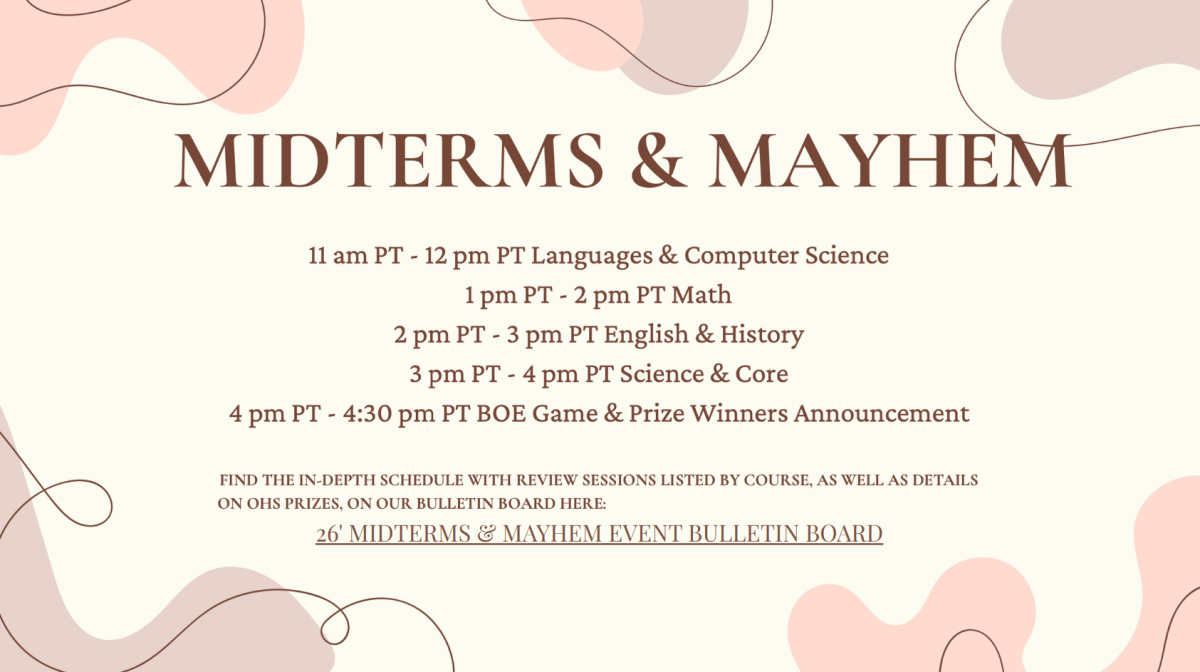
“The biggest hurdle every time is picking the schedule,” Nakagome says. This cycle, a college counseling session for juniors threatened to disrupt the time slots for each class, so the team had to work around it.
Once the schedule is determined, peer tutors and teaching assistants attend a planning session hosted by the Writing & Tutoring Center. Ms Shields, Director of the Writing & Tutoring Center says, “At this year’s planning session, Angela Zhong, Shiv Sitaram, and Hannah Nakagome shared valuable tips, strategies, and examples from past review sessions they have led. It’s exciting to see the depth of their involvement reflected in their content knowledge and their mentoring of one another.”
Angela Zhong (‘27), a tutor for Methodology of Science – Biology (OMSB9), knows that Core midterms may take the form of an essay, an exam, or both.
“I typically prepare for the Midterms & Mayhem event by making review slides tailored to the course,” Zhong explains. “Because our core curriculum differs from typical high school and OHS courses, I like to focus on how MSB specifically frames bio and stat topics.”
These review slides contain participation questions for student practice and testing tips that apply to the specific exam structure. The MSB midterm is split into two parts: an (ideally) one hour Multiple Choice section, and a two and a half hour Written Explanation section.
“OHS exams are often significantly longer than what most high school freshmen are used to,” Zhong points out. “So I pay special attention to helping them become acclimated to the … writing and thinking style of MSB. For example, how to accurately describe statistical testing and their results.”
In planning her math review sessions, Sahej Sarai (‘28), a teaching assistant for Geometry and Foundations of Proof (OM015) and a peer tutor for Principles of Chemistry (OC005) takes a different approach. “I have asked the teacher who nominated me as the teacher assistant to give me extra questions from the textbook I could add to my slideshow, so then students could have something to practice off of or have some examples to go off.”
Beyond content review, Zhong notes that it’s important to be able to read the room. She has experienced the daunting academics of MSB. The courseload and the difficulty in understanding are common experiences. Zhong understands this fear, and has come to expect some hesitance during review sessions.
“Participation can be slow at the start of thhttps://onlinehighschool.stanford.edu/courses/2026/school-year/jla1ae session. But I’ve found that students tend to warm up as the session goes along, so I try to remain flexible and prepared to adjust the format based on their questions.”
For Sarai, the greatest challenge in the planning process isn’t in leading students to solve complex equations. “The hardest part of preparation,” she says, “is reminding students that there is a Midterms and Mayhem session. Some students seem to forget about it, so definitely just having a daily reminder is important.”
To avoid missing a review session, Adriana Feng (‘28), a tutor for Latin 1A (JLA1A), advises students to “Keep an eye on the SASS bulletin for announcements or reach out directly to a SASS member. Pretty straightforward once you’re plugged in”.