

Imagine racing across nearly 2000 miles of the wild Australian outback at 60 miles per hour in the blistering 100-degree heat—in a car that recharges on sunlight while driving! In this scenario, played out by Stanford University’s Solar Car Project, there is no room for error. Every curve of the vehicle, every watt of energy collected from the sun, every line of code can determine the team’s fate.
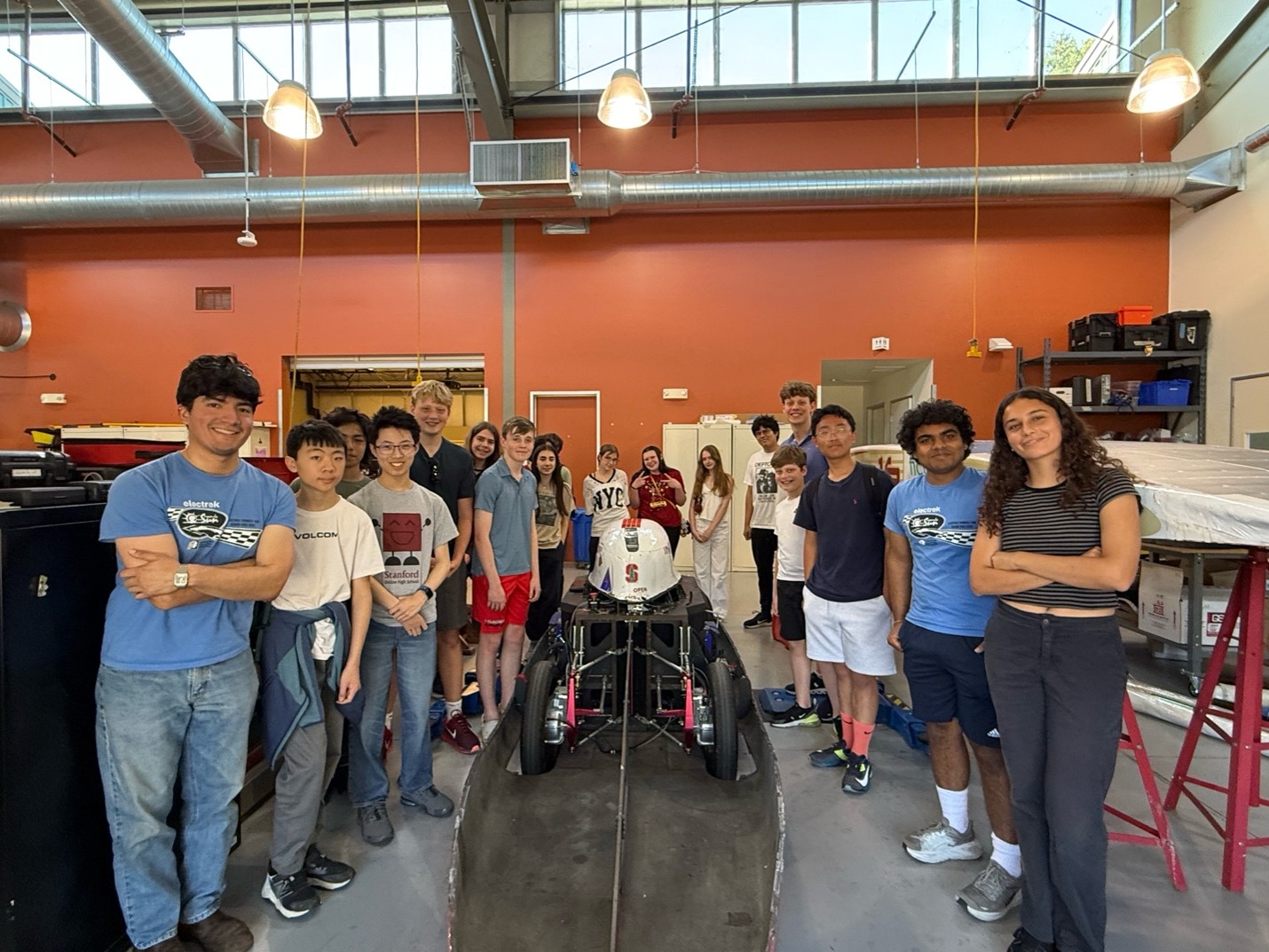
On June 4th, the Stanford Online High School Formula 1 Society toured Stanford University’s Solar Car Project, giving students a unique look inside one of the world’s most ambitious and successful student engineering teams. This event allowed attendees to see a type of racing where the challenge lay not only in competing for pure speed, but in developing a solar vehicle that is efficient, safe, and able to endure a challenging race course.
The Stanford Solar Car Project has operated as a student-run engineering team since 1986, giving undergraduates thepportunity and responsibility for design, manufacturing, budgeting, sponsorships, testing, and race logistics that were previously mostly limited to professional teams. In a typical two-year build cycle, students research regulations, create computer simulations and then move on to fabrication and final road testing, transforming computer models into carbon fiber structures, custom electrical systems, and a vehicle reliable enough for the most relentless conditions.
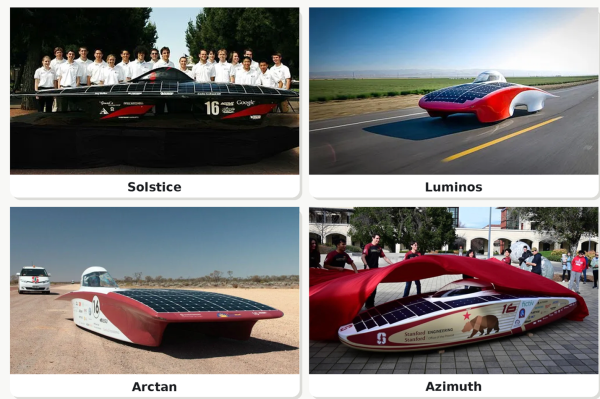
The tour began with a presentation by team safety officer Joseph Garcia on the team’s former cars and competitions, including the Formula Sun Grand Prix, American Solar Challenge, and the World Solar Challenge, the ultimate test where cars race across the Australian outback from Darwin to Adelaide. Over the decades, the team has built a long line of solar vehicles, achieving a best overall fourth place finish at the 2013 World Solar Challenge and second place podium finish at the 2025 Formula Sun Grand Prix after a multi-year pandemic hiatus. Garcia introduced students to former Stanford vehicles such as Solstice, Luminos, Arctan, and Azimuth.
At first glance, a solar car looks impossible, even hilariously futuristic, like the fever dream of some car designer. It is extremely low to the ground, covered with solar cells, and shaped more like a miniature aircraft wing than a normal vehicle. However, as Stanford Solar Car members explained, every unusual feature exists for a vital reason. The car is not designed for aesthetics, but to optimize energy.
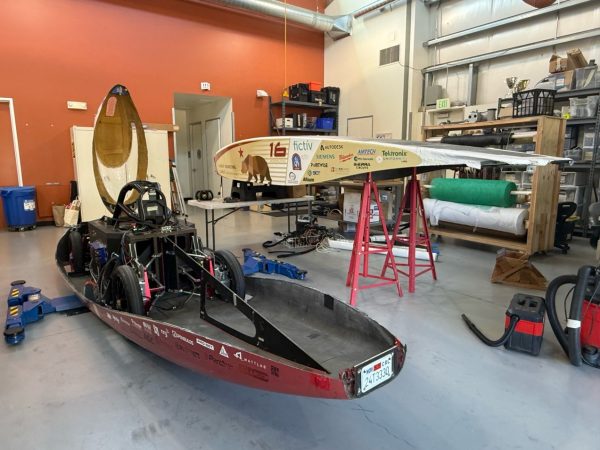
According to the team, solar racing aims to provide the best solution to one central question: how can a vehicle travel as far, as efficiently, and timely as possible using the most sunlight and stored electrical energy? That question has guided the team’s ethos during competitions from mechanical engineering to electrical systems.
Stanford Solar Car is an interdisciplinary endeavor that folds many areas of expertise into the equation. Solar array lead Sofie Roux and Garcia explained how the team is divided into subteams addressing the mechanical and electrical components. The mechanical team addresses aerodynamics, structures, vehicle dynamics, chassis design, suspension, steering and brakes. The electrical side works on solar arrays, battery, motors, custom printed circuit boards, harnessing, wiring, and code written in C for custom hardware.
“Why not simply cover the whole car with solar panels instead of leaving gaps between?” asked student participant Francesca Davies.
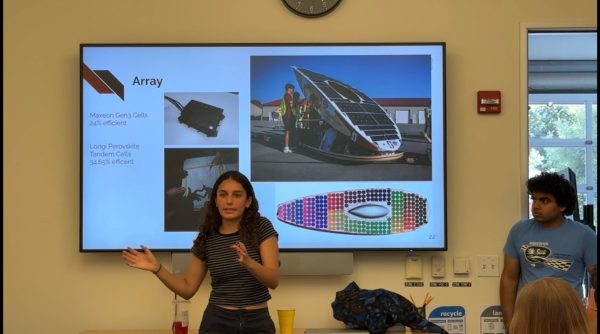
The answer from Roux and Team President Akhil Marri revealed the foundational logic behind the project: in solar car design, “more” is not automatically better. Solar arrays are manufactured in segments. Each car is only permitted 6 square meters of solar panel by the regulations. The team used modular solar panels instead of a uniform bodied one to ensure convenience when designing a protective outer casing and managing energy efficiency since the sun’s rays hit various parts of the car differently during each hour of the day. Most solar cells would not always be useful if they are placed on surfaces that are curved, shaded, or poorly angled. Moreover, a larger array could add extra weight and complexity that threaten durability and take up more space meant for other crucial parts. The best design is the one that balances the entire system.
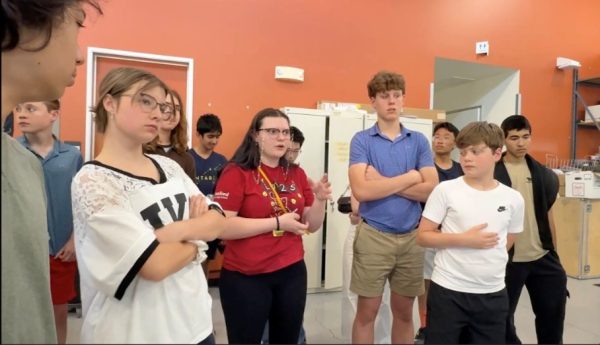
From Roux, the students learned about the intricacies of solar cells, one of the most crucial components on the car. “The team currently uses 24% efficient cells and plans to increase by 2% to reach 26% efficiency in the future.” She also mentioned a new technology called tandem cells that could reach near 35% efficiency at low cost, showing how quickly technology is evolving and becoming more accessible.
However, collecting energy through solar cells is simply the beginning of the process to build a competitive solar car. The next step is knowing where the energy goes and how to use it effectively after it enters the car.
Marri says the team uses telemetry and data analysis to “closely analyze performance, detect losses, and build software models to guide race strategy.” The car’s speed cannot be decided by instinct alone. Weather, elevation, battery state, wind, and road conditions are all variables that affect whether the team “should push harder or slow down to conserve energy.”
The reality of solar racing is far more complex than what it appears. The entire race is like a moving math equation where the goal is not only to drive as fast as possible but correctly calculate how much energy the car can collect, how much it will spend, and how much it should save for future emergencies.
Marri says, “in cross-country solar racing such as the World Solar Challenge, 95% of the car’s energy comes from the sun rather than a pre-charged battery.” This means that anything from the weather, amount of sunlight, speed, battery level, and even road angles determine overall race strategy.
The car is also not traveling alone during the race. Marri says that on a public highway, it “moves as part of a long caravan-like procession of cars. At the front is the scout car, whose task is to watch the road ahead and gather supplies for the team. There is a chase car that follows the solar car to monitor telemetry data and a few support trucks that carry the necessary repair tools and equipment in case something unexpected were to happen.”
The project also heavily depends on the work spectators rarely get to see from the outside. Students eagerly asked about funding, timelines, in-house manufacturing, and how much of the car is built by the team. The answer from team members showed that the Stanford Solar Car Project is not just an amateur assembly club but one where members balance budget with performance, working on everything from CAD, designing custom composite molds, batteries, wiring, circuit boards, integration, software, and testing.
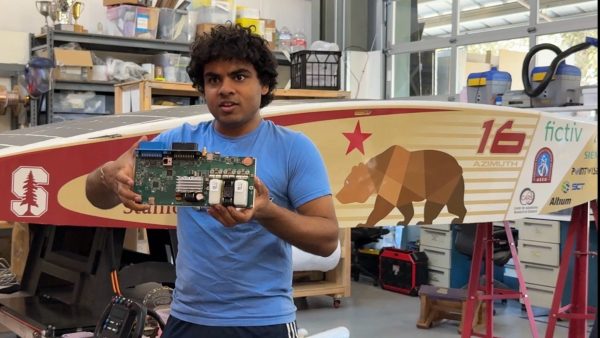
Team President Akhil Marri describes Stanford Solar Car’s own custom designed electric circuit boards. (Jacob Li)
Because the team is completely student-run, a significant hurdle is continuity. Members graduate every few years, but the project has to keep moving. The pandemic exacerbated this problem. With campus operations grinding to a halt and several classes of members graduating during the shutdown, the team lost much of its valuable hands-on “tribal” knowledge. Despite having all the schematics, team president Marri explains “it is sometimes difficult to understand why the previous team chose a specific design and how it succeeded.” The project therefore depends on the continued support of previous alumni and professionals from engineering fields, who meet with the team every year in person to give advice. In that sense, the team is not just building a car, it is building a memory that allows one generation of students to inherit the lessons of the last.
In addition to the challenge of continuity, the team faced the harsh financial reality of solar car racing. Unlike Formula 1, where a cost-cap is in place to ensure fairness among teams, solar car budgets can vary like the financial wild west.
“Some university teams may attempt a car with just $30,000 while the most competitive global teams pour millions into composite molds, advanced solar cells, lightweight materials, manufacturing, testing, and logistics, often with lucrative sponsorship backing,” Garcia says. This means that for the Stanford Solar Car Team, fundraising and attracting sponsorships are just as integral as engineering and coding in the overall equation. The team would often have to make difficult choices to decide what to buy and what not to buy. A component may improve car efficiency, but the team would also have to consider how easily it could be obtained, how long it would take to build, and if it is worth the cost relative to the performance increase.
According to Marri, the team’s next major campaign, SunStruck, is an ambitious car aimed to compete in the prestigious 2027 World Solar Challenge using AI powered computation, improved solar cells, and undergo 10,000 test miles. The last number is the most revealing. A solar car could look flawless in a model, but a race across real roads exposes all sets of problems from heat, fatigue, wiring wear, and parts that only fail after many miles.
At the end of the day, OHS students take away far more than just technical engineering knowledge from the Stanford Solar Car Project. Student participant Harlan Olsen said that before the visit, he “did not expect there to be such a large-scale, organized races,” assuming it might be “more of a Stanford specific project.” After the tour, however, he was struck by how solar racing brings together two ideas that are usually seen separately: renewable energy and competitive motorsport, “we are on the right path towards a future more heavily based in renewable power.” President Marri says he “spend(s) 3-4 hours a day on Stanford Solar Car Project during the busiest times, more time than actual schoolwork.” For him and the team, a car is not just a detached machine. It is the final result of thousands of calculations, tests, failures, and improvements. Innovation and great outcomes are rarely singular brilliant flashes of genius, but rather shaped by passion, patience, and the courage to continue improving no matter what.