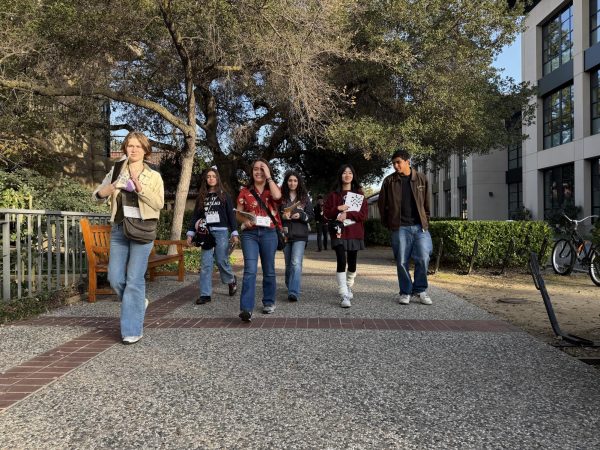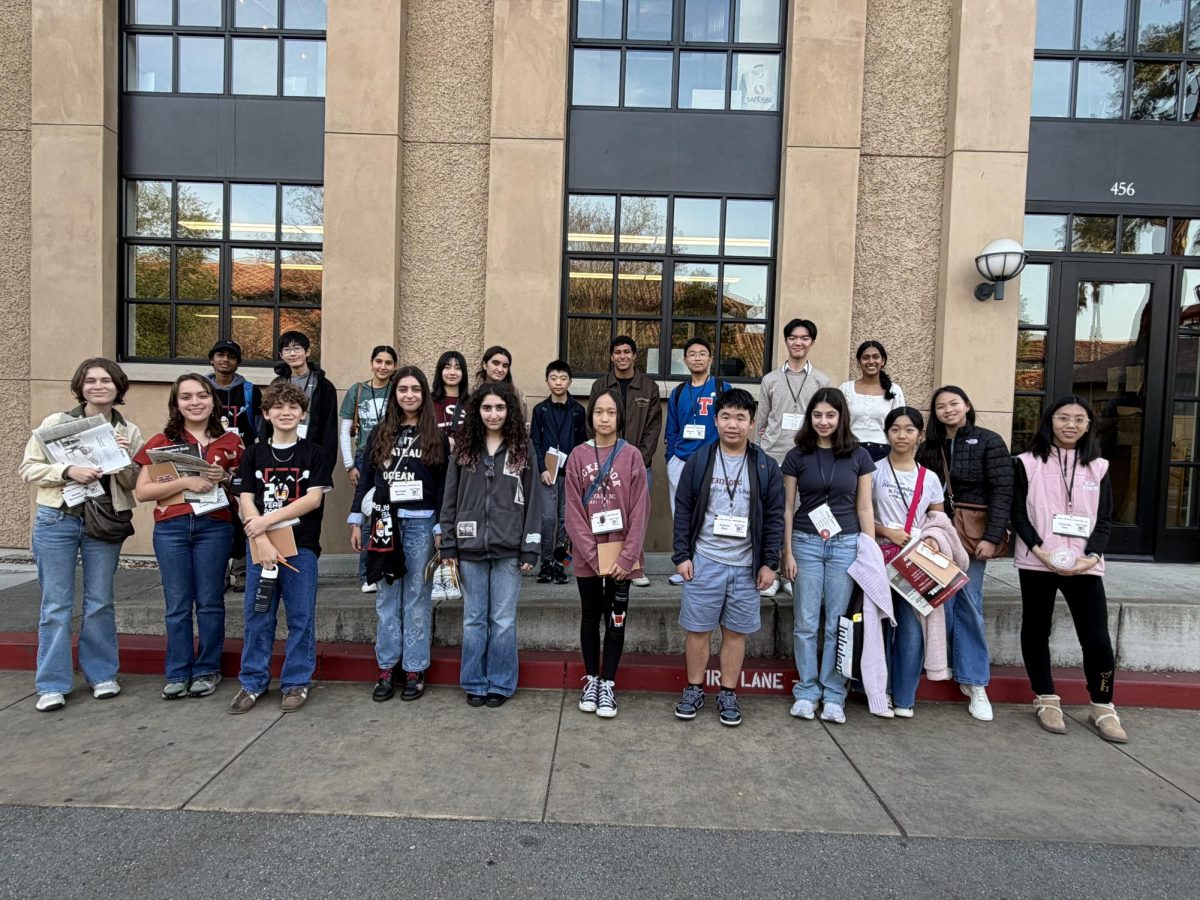
You might walk into the Lorry I. Lokey building expecting a small student club. What you find instead is The Stanford Daily, the independent news organization run entirely by students, operating with the rigor and professionalism of a major newsroom. This structure allowed student journalist Theo Baker to investigate allegations that Stanford president Marc Tessier-Lavigne had manipulated research images, helping spark what ultimately contributed to the president’s resignation.
Last Saturday, January 31, during the Pixel Festival, The Stanford Daily opened its doors for a behind-the-scenes tour. OHS alumn Sterling Davies, currently a managing editor, walked students through what it actually takes to run a paper that’s become integrated into not just campus life, but city and national news coverage.
The Infrastructure
Emma Griffith (’27) never thought about finances when it comes to newspapers. As a journalist at The Observer, she’d focused on sourcing, writing, and editing. The business side seemed distant, abstract.
The Daily changed that perspective.
“It’s so interesting how big the Stanford Daily is and how they have lawyers, and finances,” Griffith said. “We’re pretty much preparing for this.”
The Daily operates on a clear tier system. Writers start as contributing writers after five articles, then become staff writers after ten. At the start of each volume (running from June to January), students can apply for editor positions based on their strengths.
The newsroom hierarchy runs from desk editors to managing editors, then executive editors, and ultimately the editor-in-chief. Beat reporters focus on specific topics, often working their way up through the ranks.
Davies, who started as a beat reporter covering local public safety before becoming desk editor for local coverage, was initially surprised at The Daily’s complex infrastructure.
“It’s not just editors. We even have an attorney that works with us. The Stanford Daily isn’t any college newspaper—it’s integrated into the city, the nation.”
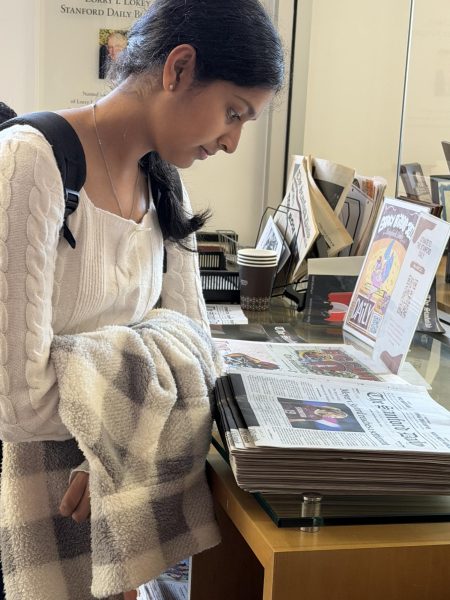
(Jolene Zjou)
Students Running a Newsroom
Managing editors at The Daily work like managers in a professional newsroom, except that they’re also full-time students.
Writers control their own pace. “We’ll have writers who come every two or three weeks to write their article, and then we have people working on five articles at the same time,” Davies said. The flexibility extends across different timeframes and schedules.
Editors don’t have that luxury. Day-to-day commitments pile up: fact-checking articles, tracking sources, ensuring publication. The workload requires strategic division of labor.
Davies explained how he and his fellow editors divided the week. For instance, he’d take Monday and Tuesday, they’d handle Wednesday and Thursday, everyone would converge for weekend pitch meetings. The system works because everyone understands the constraints. “What’s great about The Daily,” he said, “is that since it’s all students, everyone’s very understanding if something comes up and very flexible with schedule changes.”
The collaborative culture runs deeper than scheduling logistics. Davies met one of his best friends while co-writing an article, the kind of bond that forms when you’re staying up until 3 a.m. making live logs while covering an election.
“I think above all, The Daily tries to be a very collaborative and open community dedicated to journalism,” Davies said. “It’s just a great way to meet people and connect over writing.”
Covering Breaking News
When something scary happens on campus, Davies said, rumors spread. Facts get misinterpreted. The Daily’s job is to kill the misinformation fast.
Three to four hours from verification to publication.
Griffith, accustomed to the slower pace of high school journalism, was stunned by the turnaround time.
Breaking news covers anything that can’t wait until the next publishing day. The Daily publishes Sunday through Thursday, with no new content on Friday and Saturday unless something urgent happens. Regular coverage includes events like undergraduate senate or graduate student council meetings. Breaking news also tackles urgent situations where clarity is essential, preventing rumors from causing real harm.
The process moves in stages. First, verify the event is actually happening. Then reach out to essential sources, people who need to be quoted for the story to be credible. Sometimes this means phone interviews for speed, or accepting written statements when sources can’t talk in real time.
“We’re trying to draw out less objective information,” Davies explained. Interview questions avoid simple yes-or-no answers or facts easily found online. “We’re looking for emotionally driven statements” that reveal personal perspectives and context.
The Standards
The Daily requires three sources per article. Those sources must represent diverse perspectives.
Maintaining neutrality takes deliberate effort. For controversial topics, finding people from different sides of an issue becomes essential. Even opinion pieces try incorporating multiple viewpoints. For neutral topics, reporters might interview both someone who strongly dislikes something and the person who created it.
“We work hard to prioritize things,” Davies said when asked about the tension between speed and sourcing quality. If a source can respond shortly after deadline, editors wait. If it will take too long, reporters find someone else or request written statements.
The Daily splits its content into two distinct categories. Articles cover short-form, breaking news, and timely pitches. The Stanford Daily Magazine focuses on long-form content built around themes.
“It’s one of my favorite parts of the Daily because it gives us time to do long-form content and get a break from the shorter, faster pieces,” Davies explained. Magazine has separate editors and operates on a more curated timeline.
Writers face almost no restrictions on topics. The Daily offers flexibility across all sections except opinions, where editorial oversight remains tighter.
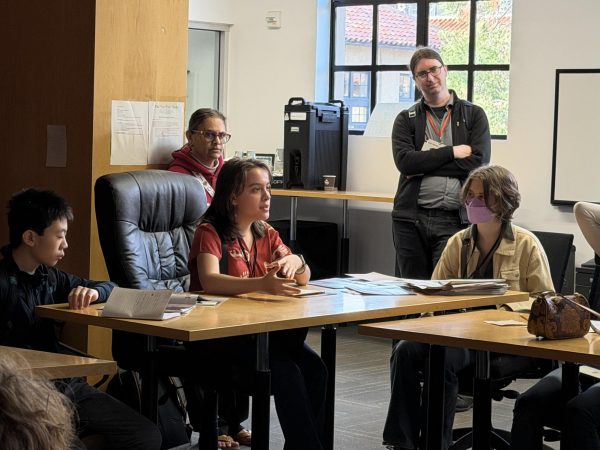
The Visual Story
The Daily photography team handles visual coverage, sometimes traveling to events, sometimes coordinating with writers on-site. During a campus walkout, for instance, both writer and photographer would cover the event together.
For big events, distant locations, or hard-to-capture moments, photographers become essential. Writers also ask sources for photos when needed. The coordination requires strategy: when collaborating, writers make sure they’re not reaching out to the same person or covering identical angles within an article.
What It Means
Revathi Sundaresan, an OHS math instructor who reads five newspapers every day, pointed to Theo Baker’s investigation as proof of what student journalism can accomplish when given proper infrastructure and independence.
“I was amazed that they’re able to work like professional journalists while still being students,” Sundaresan said. “The range of topics they cover, the quality of the work.”
For aspiring student journalists at OHS, the Daily serves as both inspiration and blueprint, proof that “student newspaper” doesn’t have to mean limited scope or amateur execution.
“It’s a noble profession,” Sundaresan said. “Democracy lives only when there is freedom in journalism. The truth needs to be told.”